
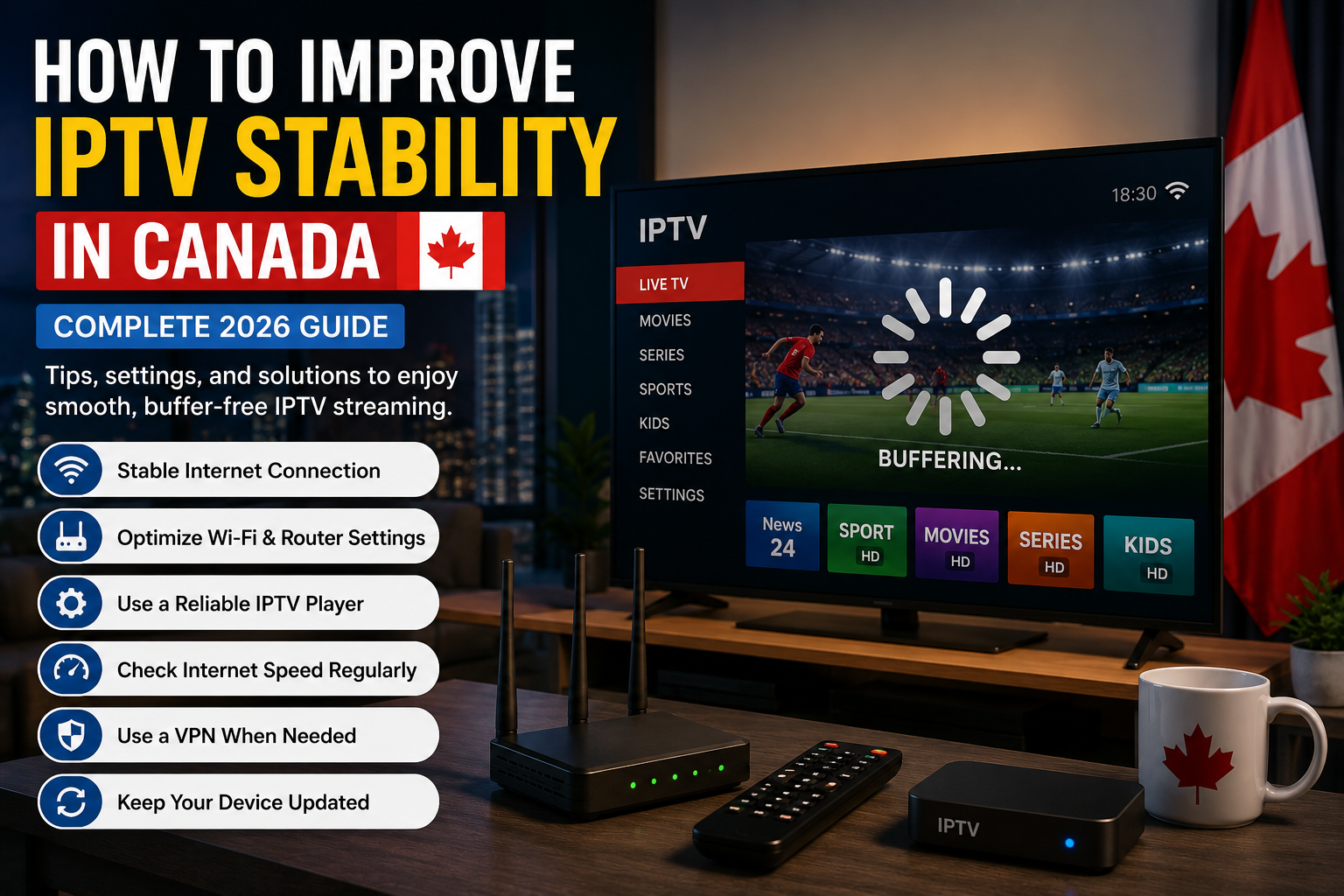
Are you looking for the ultimate guide on how to improve IPTV stability in Canada? If you live in North America, you are definitely not alone. Many cord-cutters rely on IPTV to watch live TV, but maintaining a crisp, lag-free feed can feel like a constant struggle. Fortunately, understanding how to improve IPTV stability in Canada is completely within your control. By making a few targeted adjustments to your home network, software settings, and connection protocols, you can transform a frustrating, stuttering feed into a seamless, high-definition viewing experience. This comprehensive guide outlines the exact, step-by-step measures you can take today to maximize your digital television stability.
Why Understanding How to Improve IPTV Stability in Canada Matters
Before diving into technical solutions, it is essential to understand why digital television streams stutter in the first place. When learning how to improve IPTV stability in Canada, you must realize that unlike traditional cable, which uses dedicated infrastructure, modern web-based broadcasts break video files into millions of tiny data packets. These packets travel across the public web from your iptv subscription host to your local hardware.
If even a tiny percentage of those packets get delayed, lost, or mixed up along the way, your media player has to pause and wait for the missing parts to arrive. This delay is what we experience as buffering. Typically, streaming interruptions stem from three main bottlenecks:
Hardware Constraints: Your streaming box, smart TV, or router does not have the processing power to decode the stream smoothly., let’s look at how to systematically eliminate these problems.
Network Congestion: Your internet pipeline is overloaded by too many active devices.
ISP Interventions: Local telecom companies intentionally slow down high-bandwidth data, affecting even the best iptv canada streams.
Defeating ISP Throttling and Regional Blocks
In Canada, major telecom providers manage network traffic aggressively. During peak viewing hours—such as weekend afternoons or major sporting events—broadband providers often implement “traffic shaping”. They selectively slow down high-bandwidth video streams to prevent network congestion and preserve their profit margins. Additionally, local courts frequently order internet providers to block known streaming links, especially during live sports broadcasts.
The absolute best way to bypass these artificial roadblocks is by routing your connection through an encrypted tunnel. By hiding your online activity, your local internet provider cannot detect what kind of media you are playing, meaning they cannot selectively slow it down.
When looking for a solid companion service, you will need a premium iptv subscription to ensure you are getting a high-quality source from the start. Combining a premium provider with a reliable virtual private network (VPN) is the gold standard for uninterrupted playback. When setting up your VPN, always connect to a local domestic server to keep physical latency as low as possible.
Optimizing Your Local Network Hardware
Even the fastest fiber-optic package will feel sluggish if your home network setup is outdated. Wi-Fi is incredibly convenient, but it is highly susceptible to physical interference from walls, metal appliances, and even your neighbor’s wireless devices.
Ditch Wi-Fi for a Wired Ethernet Link
If you take away only one piece of advice from this guide, let it be this: plug your device directly into your router. A physical category 6 (Cat6) ethernet cable eliminates packet loss, dropouts, and wireless interference instantly.
If your streaming box sits too far from your modem, consider using powerline adapters. These clever devices transmit your internet data through your home’s existing electrical wiring, giving you the stability of a hardwired connection without running long cables across the floor.
Prioritize Your Traffic via Quality of Service (QoS)
Most modern routers feature a tool called Quality of Service. QoS allows you to designate specific applications or devices as high-priority. By logging into your router’s administrative dashboard, you can set your streaming box as the top priority. This ensures that even if someone else in the house starts downloading a massive file or playing an online game, your live broadcast remains completely unaffected.
Fine-Tuning Your Player Settings
The software player you choose to parse your digital feed plays a major role in how smoothly your video renders. While there are dozens of applications available, selecting the right one and tweaking its settings can instantly boost stability.
| Optimization Setting | Recommended Action |
| Hardware Decoding | Switch decoder from “Software” to “Hardware” |
| Buffer Size | Set to “Normal” or “Large” (around 5-10 seconds) |
| Cache Clearance | Clear application cache weekly |
| DNS Settings | Switch to Cloudflare (1.1.1.1) or Google |
Adjust Your Buffer Buffer Size
Many premium players allow you to manually adjust how much video data is pre-downloaded before it plays on screen. While a larger buffer creates a slight delay when you first switch channels, it provides a massive safety net. If your connection drops for a brief second, the player will simply read from its stored memory, keeping your video playing smoothly without a single stutter. Increasing the buffer size is one of the easiest ways to learn How to Improve IPTV Stability in Canada, especially for users who experience occasional buffering during live streaming. For anyone researching How to Improve IPTV Stability in Canada, adjusting the buffer settings correctly can greatly improve playback consistency and reduce interruptions.
Regularly Clear Your Application Cache
Over time, media players accumulate temporary data, system logs, and old images that can slow down your device’s operating system. Navigating to your device’s application settings and manually clearing the cache once a week keeps the system running fast and prevents unexpected software crashes.
Hardware Upgrades for Uninterrupted Playback
Many casual viewers try to run high-definition video feeds on underpowered hardware, such as cheap Android sticks or the built-in operating systems of older smart TVs. These older chips simply do not have the processing power or system memory (RAM) required to decode high-resolution video streams continuously without overheating.
Upgrading to a dedicated, high-performance streaming device—such as an Apple TV 4K, NVIDIA Shield TV Pro, or a modern Fire TV Cube—can significantly improve streaming quality. This is one of the most effective ways to How to Improve IPTV Stability in Canada, as powerful hardware delivers smoother playback, faster channel loading, and fewer interruptions during HD and 4K streaming.
Additionally, make it a habit to close any applications running in the background. Media sticks are notorious for keeping dormant apps active, which quietly drains your device’s memory and causes video rendering to stutter. Following these simple maintenance steps is another proven method for How to Improve IPTV Stability in Canada, helping users enjoy more reliable and consistent IPTV streaming every day.
Conclusion: Master How to Improve IPTV Stability in Canada
Ultimately, achieving flawless video delivery is all about removing friction points. By learning how to improve IPTV stability in Canada, bypassing provider throttling, opting for wired connections, using high-performance hardware, and selecting the right digital delivery method, you can build an incredibly resilient system.
If you are looking to access local broadcasts, live international events, or on-demand entertainment, taking the time to optimize your setup is the ultimate way to enjoy a buffer-free iptv canada connection. With these technical strategies in place, you can finally say goodbye to the buffering wheel for good.